
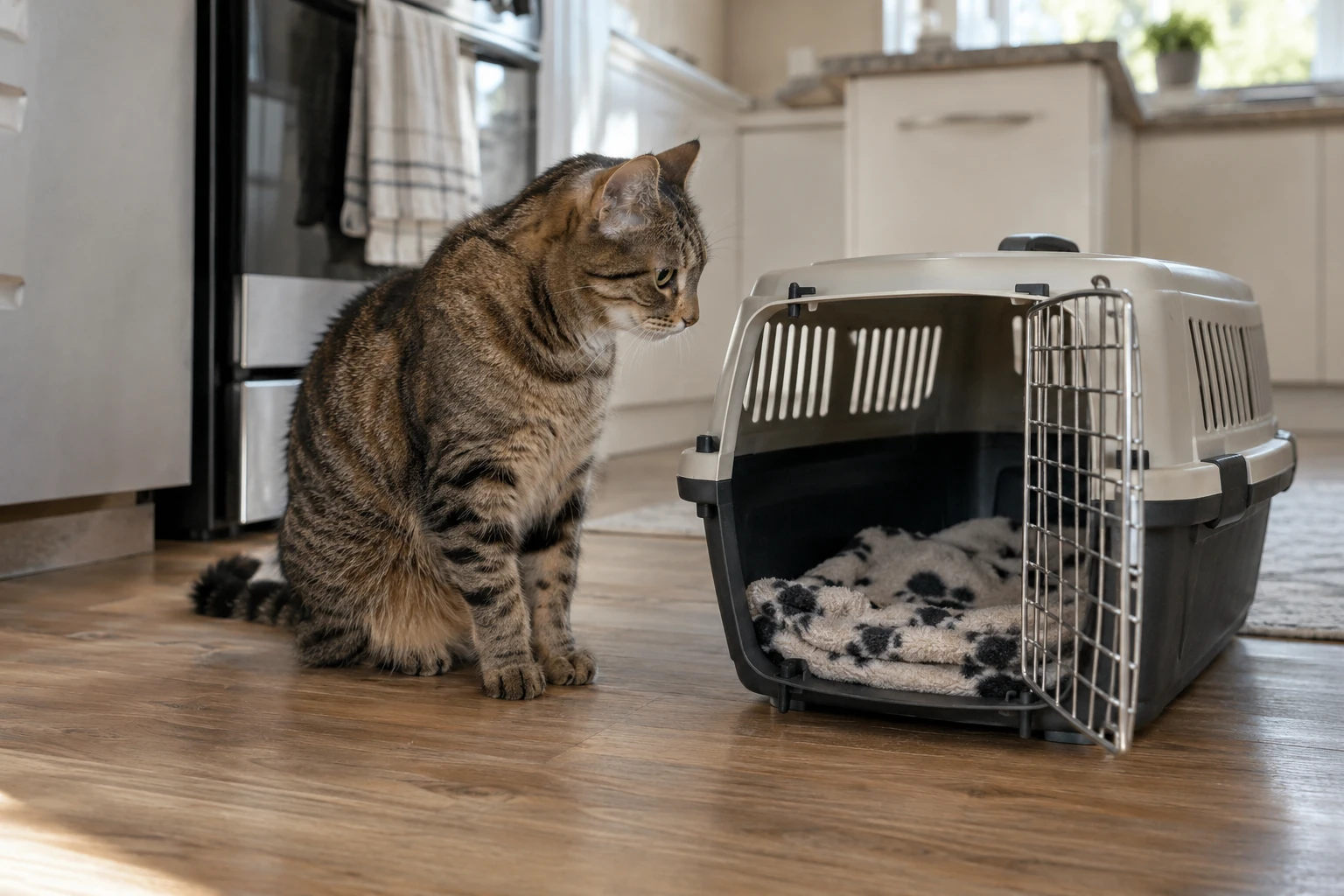
The cupboard door becomes a signal
If a carrier appears only immediately before an unfamiliar journey, the box itself can become part of the difficulty. A more useful starting point is ordinary familiarity: a clean carrier in a quiet room, with the door open and a familiar blanket inside. Let the animal investigate at its own pace.
This is preparation, not a guarantee of calm behaviour. Some cats need individual advice from a veterinary professional. A different carrier can improve access and handling, but it cannot answer every reason an animal finds travel difficult.
Getting in is only half the problem
You need to place the cat inside without a prolonged struggle, carry it level and remove it safely at the destination. Think about all three stages. A narrow opening may complicate handling even when the interior is large enough. A latch that is awkward for you is a poor choice when your attention is divided.
Check the cat’s size against the manufacturer’s guidance and allow for the bedding you plan to use. Do not choose solely by the outside dimensions or a photograph showing a smaller animal.
Inspect the parts you will touch
Open and close every access point. Notice whether the door seats clearly, how the locking mechanism feels and whether the handle is comfortable when the carrier is loaded appropriately. Ventilation openings must remain unobstructed during use. Keep the carrier out of direct sun and follow the product’s handling instructions.
For car travel, consult the vehicle and carrier guidance about positioning and securing it. A carrying handle is not proof of crash-test performance.
Air travel is a separate matter: acceptance depends on the airline and the particular journey.
Make a short preparation routine
Set the carrier out ahead of time, add familiar bedding and keep the surroundings quiet. On the day, inspect the latches and check that loose accessories cannot obstruct the cat or door. Lift gently and avoid swinging the box as you walk.
Bring the information needed for the appointment or journey separately so you are not searching through bags while holding the carrier. If your cat repeatedly panics or becomes unwell during transport, speak with your vet about an appropriate plan rather than relying on a purchase alone.
The Cabrio’s access options
The Pets at Home listing describes top access, a clear front door and ventilation on the Catit Cabrio. These are relevant features when comparing how a cat enters, how you can see it and how the carrier opens at a destination. They do not establish that every animal will find the same model comfortable.
Read the current dimensions, weight guidance and assembly instructions. Consider cleaning too: bedding and any food or water components need to be manageable between trips. Check the seller’s current terms and the specific product version before ordering.
Make the next journey less improvised
The useful result is a routine you can carry out without rushing. A suitable carrier, familiar bedding, a checked latch and a planned route remove small uncertainties before you leave. They also give you more attention for the animal.
If your present carrier is sound, appropriately sized and easy to use, familiarity may be more valuable than replacing it. Buy when you can name the handling or fit problem the new design addresses. Then allow time for that new box to become an ordinary part of the room.
Common questions
Is this automatically accepted by airlines?
No. Check the airline’s rules for your exact journey and the carrier dimensions.
Does a new carrier guarantee a calm cat?
No. Familiarity and individual veterinary advice may still be needed.
Which dimensions should I check?
Check internal space and the maker’s size and weight guidance, allowing for bedding.
Sources and disclosure
Sources checked: 2026-10-16
Advertising article. A commercial link leads to the named seller; a commission is possible only if a referral agreement covers it. The seller handles the offer.